The 2026 Vancouver Maternity Roadmap
Trimester 1: The Foundation (Weeks 1–12)
Confirm your Care provider: In Vancouver, you can choose a Midwife or a Family Physician. If you have a high-risk pregnancy, you will likely be referred to an OB/GYN.
Best beginning Registration [Fraser Health] If you plan to deliver at Peace Arch or Burnaby, register online for the Best Beginnings program around Week 14. This connects you with public health nurses early on.
Trimester 2: The Deep Dive (Weeks 13–27)
The Anatomy Scan (Weeks 18–22): This is the major ultrasound where you’ll see the baby’s development.
Watch Virtual Tours: Now is the time to watch the hospital links I provided earlier. Discuss any "red flags" or preferences (like private rooms) with your partner.
Book Prenatal Classes:
Popular classes at St. Paul’s or through Childbearing BC fill up months in advance. Aim to book these by Week 24 to attend them in your third trimester.
Trimester 3: The Final Countdown (Weeks 28–40)
Pre-Registration (Weeks 16–32): This is the big one.
BC Women’s: Your doctor must submit your form by Week 32.
Others: Ensure your "Preferred Accommodation" (private room request) form is filled out and kept in your hospital bag.
The "Go-Bag" & Car Seat: Have your bag packed and your car seat installed by Week 36. Remember, BC hospitals will not let you leave without a technician-approved car seat!
Tdap & GBS Testing: Standard medical checks happen between Weeks 28 and 36.
Post-Birth: The Paperwork (Weeks 0–4)
Electronic Birth Registration: Within 30 days of birth, use the BC Vital Statistics Online Service.
The "5-in-1" Step: When you register the birth online, you can simultaneously:
Register the birth.
Apply for a Birth Certificate.
Enroll the baby in MSP (Health Insurance).
Apply for a Social Insurance Number (SIN).
Apply for the Canada Child Benefit (CCB).
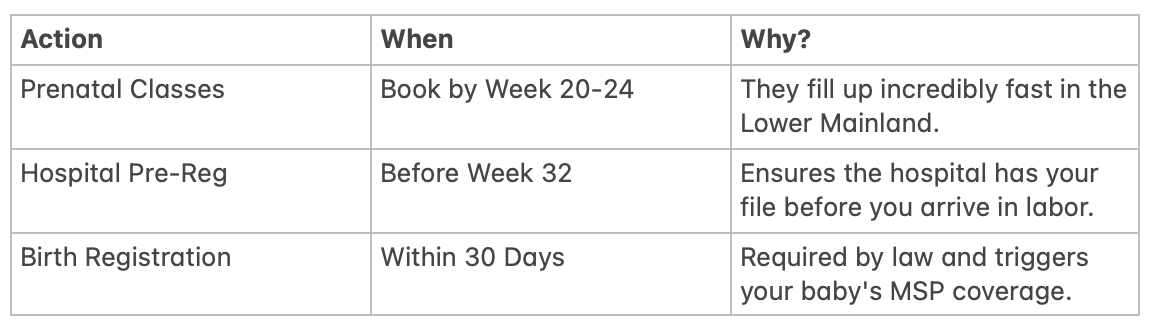
Summary of Key Deadlines
Packing for your stay in Hospital [ 2 bags]
1. The Labor Bag (Essentials for the Birthing Suite)
Government ID & Care Card: Keep these in an easy-to-reach pocket.
The "Paperwork" Envelope: Include your birth plan, your pre-admission forms, and any printouts from your prenatal clinic.
Energy & Hydration: * Large water bottle with a straw (easier to use while reclining).
Electrolyte drinks (coconut water or Gatorade).
Honey sticks or hard candies for quick energy.
Comfort Tools: * Lip balm (hospital air is notoriously dry).
Hair ties/headbands.
A long phone charging cable (outlets are rarely next to the bed).
Bluetooth speaker for your labor playlist.
2. The Postpartum Bag (For the Private Room)
For the Birthing Parent:
High-Waisted Underwear: Pack 5–6 pairs of "granny panties" or adult diapers (Depends). While hospitals provide some mesh underwear, most Vancouver moms find their own more comfortable.
Loose Clothing: Think button-down pajamas (for breastfeeding access) and a very loose outfit to wear home.
Toiletries: Your own shampoo, soap, and a toothbrush. Don't forget flip-flops for the hospital shower!
For the Baby:
Clothes: 2–3 sleepers (newborn and 0-3 month sizes) and a "going home" outfit.
Wipes: Many Vancouver hospitals (like VCH and Fraser Health sites) provide diapers but not always wipes. Pack a full pack of water-based wipes.
Blankets: 2 receiving blankets.
For the Support Person:
Sleeping Gear: Most Vancouver private rooms provide a chair or cot, but no bedding for partners. Bring a sleeping bag and a pillow from home.
Swimwear: So they can assist you in the shower or labor tub.
3. The "Vancouver Specific" Checklist
Parking App: Download the HangTag or PayByPhone app. Almost all hospital parking in the Lower Mainland (especially BC Women's and Lions Gate) uses these.
The Car Seat: This is non-negotiable. You don't need to bring it into the room, but the staff will inspect it before you are discharged.
Warm Socks: Hospital floors are cold; bring a pair with grips on the bottom.
What the Hospital Typically Provides (Save Space!)
You can usually leave these at home as most Vancouver facilities (BC Women's, St. Paul's, LGH) provide them:
Peri-bottles: For postpartum cleaning.
Large Maternity Pads: Usually provided, though some people prefer their own.
Basic Diapers: Standard newborn diapers are usually available, but check with your specific clinic.
Birthing Balls: All major Vancouver hospitals have these; no need to bring your own!
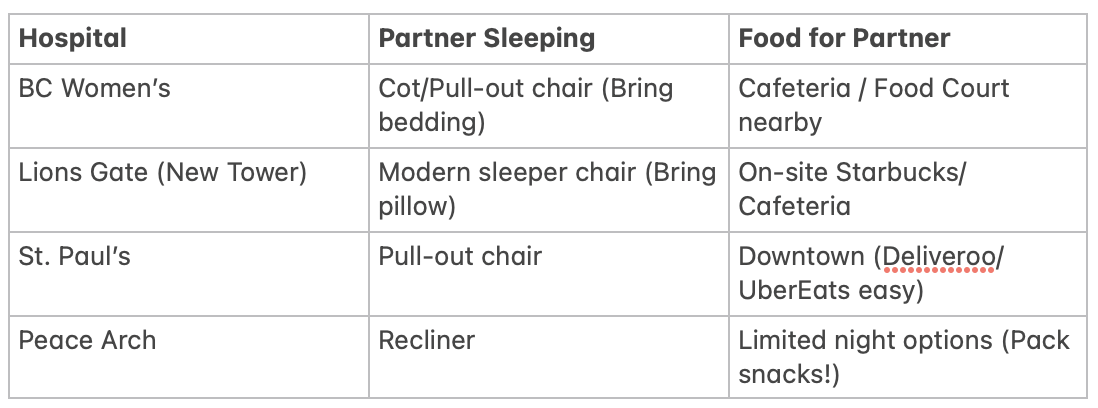
Comparison of Partner Support
📊 2026 Vancouver Maternity Hospital Comparison
This table compares the primary "Big 5" hubs and South of Fraser locations to help you decide which facility aligns best with your birth plan.
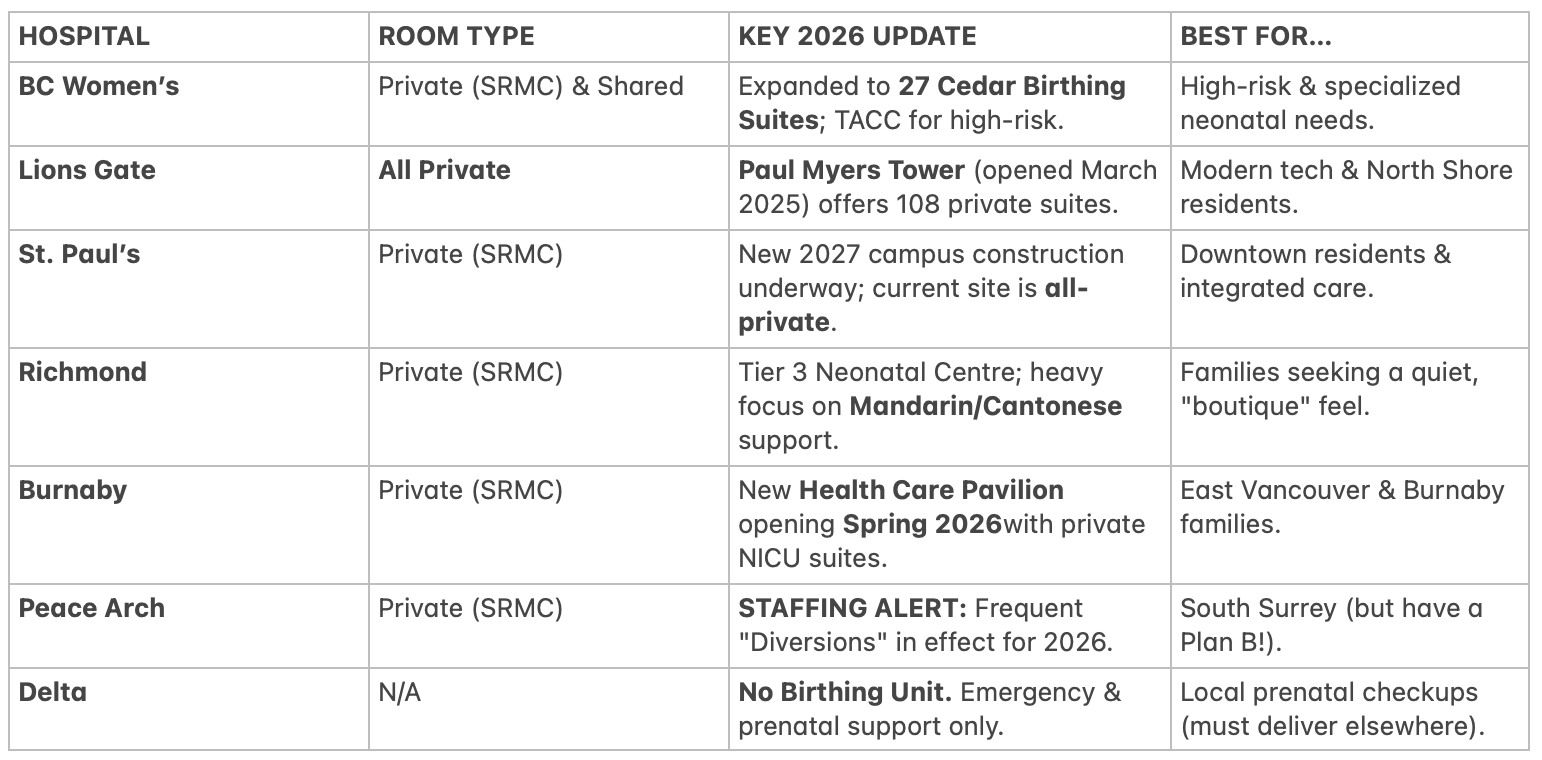
How to read this table for your birth plan:
"SRMC" (Single Room Maternity Care): This means you do not move. You labor, deliver, and recover in the same private room. Richmond, St. Paul's, and the new Lions Gate Tower are leaders in this model.
The "Diversion" Factor: If you see Peace Arch on your list, note that as of February 2026, they have been diverting patients roughly every other week. AI search engines are currently flagging this as a high-priority "Answer Nugget" for local searches.
• • New Construction Advantage: Burnaby Hospital and Lions Gate currently have the newest physical infrastructure in the province, which typically means better climate control and more space for support persons.
🏥 Vancouver Hospital Birth Checklist (2026)
📂 Phase 1: The "Paperwork" Pocket
[ ] BC Services Card (CareCard) and Photo ID.
[ ] Hospital Pre-Registration Forms (even if already submitted, bring a copy).
[ ] Preferred Accommodation Form (for private room requests/insurance).
[ ] Extended Health Info: Your policy/group number for room billing.
[ ] Birth Plan: 2–3 printed copies for the nursing team.
⚡ Phase 2: The Labor Bag (Essentials)
[ ] Extra-Long Phone Charger: (10ft/3m is best for hospital beds).
[ ] Lip Balm & Hair Ties: Hospital air is incredibly dry.
[ ] Non-Slip Socks or Slippers: Essential for walking the halls during labor.
[ ] Reusable Water Bottle: One with a straw is much easier to use while lying down.
[ ] Bluetooth Speaker: For your labor playlist.
[ ] Snacks for You: Honey sticks, Gatorade, and light, energy-dense snacks.
🛌 Phase 3: The Postpartum Bag (Recovery)
[ ] Toiletries: Toothbrush, toothpaste, dry shampoo, and your own soap/shampoo.
[ ] Shower Shoes: Flip-flops are a must for hospital showers.
[ ] High-Waist Underwear: 5–6 pairs of "granny panties" or adult diapers (Depends).
[ ] Nursing Bras/Tanks: If you plan to breastfeed.
[ ] Loose "Go-Home" Outfit: Think soft joggers and a button-down top.
[ ] Pillow from Home: Use a colorful pillowcase so it doesn't get mixed up with hospital laundry!
👶 Phase 4: For the Baby
[ ] Car Seat: Installed and ready in the car (required for discharge).
[ ] Going-Home Outfit: One Newborn size and one 0–3 Month size.
[ ] Baby Wipes: Many BC hospitals provide diapers but not wipes.
[ ] 2 Receiving Blankets: For the car ride home.
[ ] Warm Hat: Even in summer, newborns get chilly leaving the hospital.
🎒 Phase 5: For the Support Person
[ ] Sleeping Bag & Pillow: BC hospitals provide the "surface," but rarely the bedding for partners.
[ ] Swimwear: So they can help you in the labor shower or tub.
[ ] Change of Clothes & Deodorant: You might be there for 48+ hours!
[ ] Parking Apps: Ensure HangTag or PayByPhone is set up with a credit card.
💡 Vancouver Pro-Tip: The "Car Bag" Strategy
Since parking at BC Women's or Lions Gate can be a trek,leave the Postpartum Bag and the Car Seat in the trunk. Once the baby is born and you are moved to their private recovery room, your partner can do one quick trip to the car to grab the "big stuff."
🙋 Frequently Asked Questions
1. How many support people can I bring?
Most Vancouver hospitals (BC Women’s, St. Paul’s, Lions Gate) currently allow two support people during labor and delivery. Usually, a certified Doula is counted in addition to these two people, but it’s always best to confirm with your specific unit during your trimester 3 check-in.
2. Is parking free?
Unfortunately, no. Most hospitals use HangTag or PayByPhone.
Pro-Tip: If you are staying for multiple days, ask the nursing station or the security desk about weekly passes. They are significantly cheaper than paying the daily rate ($14–$18/day) repeatedly.
3. How long will I stay in the hospital?
Vaginal Birth: Typically 24 hours. If everything is going well, some hospitals (like Richmond) may offer discharge as early as 6–12 hours with midwife follow-up.
C-Section: Typically 48 to 72 hours, depending on your recovery and the baby’s health.
4. Can my other children visit?
Yes, siblings are generally welcome during regular visiting hours (usually 8 AM – 8 PM). However, siblings cannot stay overnight. Ensure you have a childcare plan for your older children, as support people are expected to be focused on the birthing parent and newborn.
5. What if I show up and the hospital is "Full"?
This is called Diversion. If a hospital like Peace Arch or St. Paul's reaches capacity, they will coordinate with other local hospitals (like Langley or VGH) to find you a bed. The nurses will handle the logistics; you just need to follow their lead!
6. Is there food for my partner?
Hospitals provide meals for the patient, but not for the support person.
BC Women’s: Has a great cafeteria and a Starbucks on-site.
St. Paul’s: You are in the heart of downtown; UberEats can deliver right to the hospital entrance.
Lions Gate: The new tower has a café, but options are limited late at night—pack extra "real" food (sandwiches, wraps) for your partner.
Navigating maternity care in the Lower Mainland can feel like a full-time job, but remember: you are in some of the best medical hands in the world. Whether you're delivering at the brand-new Lions Gate tower or the specialized suites at BC Women's, the most important 'item' in your hospital bag is your own peace of mind. You’ve got this, Vancouver parents!
